


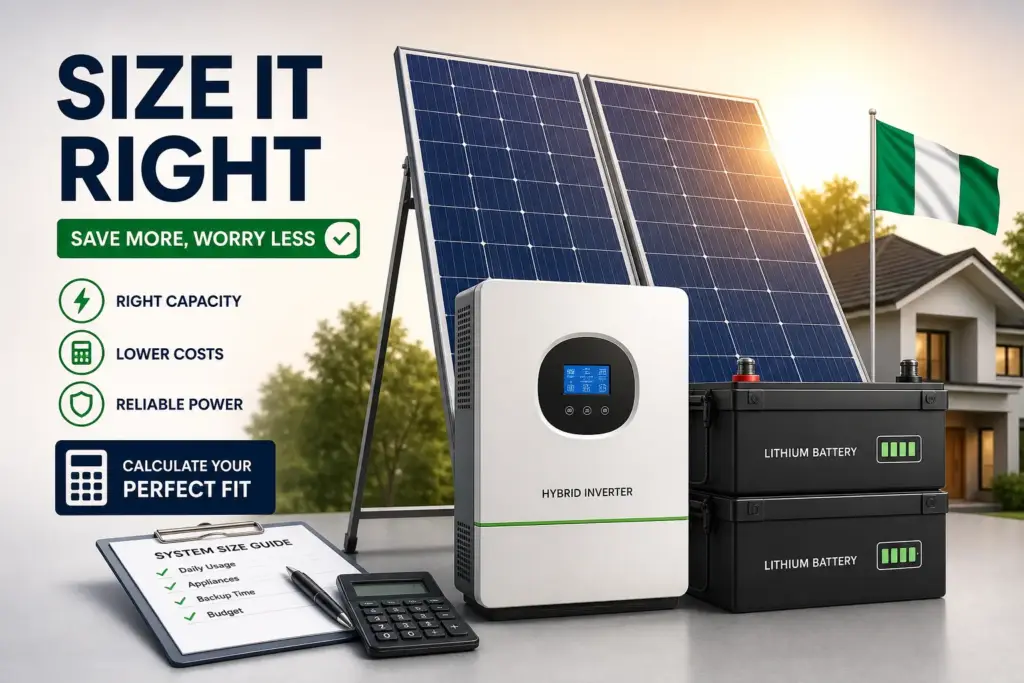
When homeowners get solar system sizing in Nigeria wrong, the result is painfully predictable: a ₦400,000-plus solar setup that leaves the inverter beeping and the batteries dead by 9pm. The equipment isn’t faulty. The installer wasn’t necessarily incompetent. The problem is almost always the same, nobody ran the actual numbers before buying.
Too many buyers size their systems by copying a neighbor, asking a seller what they can afford, or guessing based on what “sounds right.” That approach works about as well as measuring your window for curtains by eyeballing it. Accurate solar system sizing in Nigeria requires three real inputs: your daily energy consumption in kilowatt-hours, your location’s peak sun hours, and the autonomy your battery bank needs to provide. Everything else flows from those three numbers.
At Solar Power Solutions, we’ve been working through this calculation with Nigerian households and businesses since the company launched. The process isn’t complicated, but it has to be done in the right order. By the end of this guide, you’ll have a working estimate for your PV array size in kilowatts, your inverter rating in kVA, and your battery capacity in amp-hours, plus a clear picture of what that system will cost you in 2026.
Why most Nigerian solar systems fail to deliver (and it’s not the hardware)
Two mistakes account for the majority of underperforming solar installations in Nigeria. The first is buying an inverter sized to your budget rather than your load. The second is assuming a 1kW system will cover “the basics” without ever defining what the basics actually draw in watts. Both mistakes feel reasonable in the moment and both lead to the same result: a system that disappoints from day one.
Undersizing your battery bank causes deep cycling, which substantially shortens lead-acid battery life, often to a fraction of the 3 to 5 years they’re designed to last, depending on how severely they’re cycled each day. An undersized PV array means your batteries never fully recharge during the day, so each night you’re drawing from an already-depleted bank. An inverter that’s too small shuts down under peak load, usually right when you need it most. Oversizing, on the other hand, wastes capital you could have put toward a better battery bank or higher-efficiency panels.
The real cost of getting solar sizing wrong
When a battery bank deep-cycles daily, you’re not just shortening its lifespan, you’re paying full replacement cost on a system that was never set up to succeed. A 200Ah tubular battery bank that costs ₦180,000 today shouldn’t need premature replacement, but chronically undersized systems routinely force exactly that outcome. In cities like Lagos and Port Harcourt, where grid supply is often intermittent, check local DISCOM schedules for current supply patterns in your area, the battery bank has to do heavy lifting every single night. It can only do that if it was sized for the job.
What “correct sizing” actually means
A correctly sized system meets your average daily load on a typical low-sun day (the design month), provides at least one day of battery autonomy without a recharge, and stays within inverter capacity even when multiple appliances run simultaneously at peak. That definition is the benchmark for every calculation in this guide. It’s a higher bar than “works most of the time,” but it’s the bar a well-designed system should clear consistently.
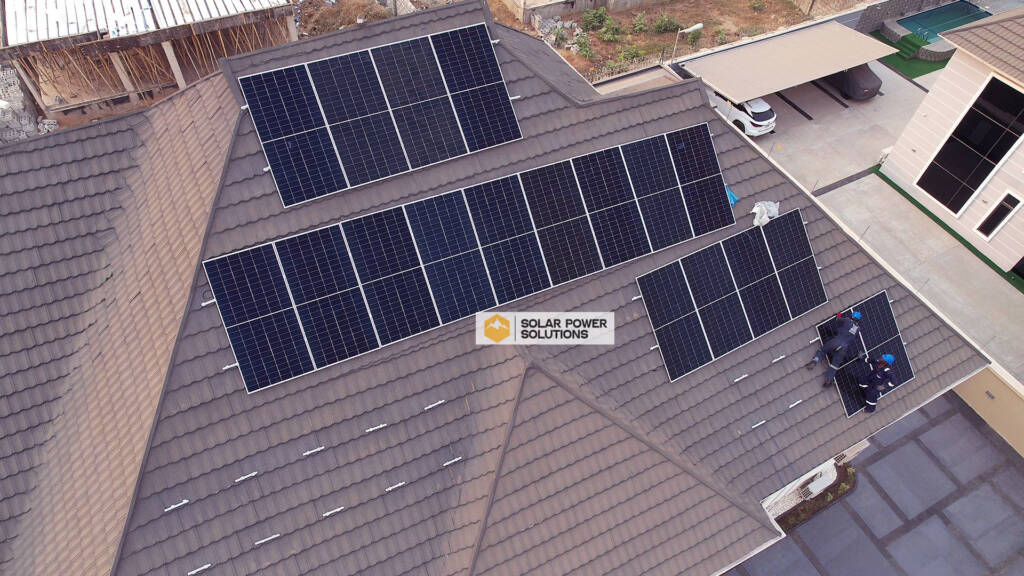
Solar System Sizing Nigeria, Step 1: Build Your Load List and Calculate Daily kWh
This is the most important step in the entire process. Your daily energy consumption figure, expressed in kilowatt-hours per day, determines every other component in your system. Get this number right and the rest of the calculation follows cleanly; skip it and you’re guessing.
The method is straightforward.
- List every appliance you want to run on solar and record its rated wattage.
- Estimate how many hours per day you use each one.
- Multiply watts by hours to get watt-hours per day for that appliance, then sum all appliances to get your total daily watt-hours.
- Divide by 1,000 to convert to kilowatt-hours.
That single number drives everything that follows.
How to read appliance wattages accurately
The wattage printed on a fridge or freezer nameplate is its maximum draw, not its average draw. Compressor appliances cycle on and off throughout the day, so their effective consumption is lower than the nameplate suggests.
A practical rule is to apply a 30 to 40 percent duty cycle to fridges and freezers when estimating daily usage, though the exact figure depends on the model and ambient temperature, so a plug-in watt meter gives you the most accurate reading.
Using a 35% duty cycle as a starting estimate: a 150W fridge running 24 hours draws an effective 52.5W, or about 1.26 kWh/day. For older appliances where the nameplate is missing or illegible, an inexpensive plug-in watt meter (widely available from solar and electronics retailers in Nigeria) removes all the guesswork.
For quick reference on typical appliance draws, consult published lists of common appliance wattages.
Sample load table for a 3-bedroom flat
Here’s a worked example for a typical Nigerian 3-bedroom household targeting reliable backup power for essential loads:
| Appliance | Watts | Hours/Day | Wh/Day |
|---|---|---|---|
| Fridge (with duty cycle) | 150W × 35% | 24 | 1,260 |
| 3 ceiling fans | 75W each | 10 | 2,250 |
| 8 LED bulbs | 10W each | 6 | 480 |
| TV (32 or 43 inch) | 100W | 4 | 400 |
| Water pump | 250W | 1 | 250 |
| Router/decoder | 25W | 8 | 200 |
| Total | ~4,840 Wh (~4.85 kWh) |
Round that up to 5 kWh/day as your working baseline, the number we’ll carry through Steps 2 and 3.
Step 2: Adjust for Nigeria’s Peak Sun Hours and System Losses
Raw sunlight hours and usable solar energy are not the same thing. Peak Sun Hours (PSH) measure the equivalent number of hours per day at peak irradiance (1,000 W/m²), not total daylight.
A cloudy six-hour day in Lagos might deliver only 3.5 PSH of usable solar energy. This distinction matters a great deal for PV system sizing in Nigeria; see a short primer on what peak sun hours mean.
Peak sun hours by region in Nigeria
Nigeria splits into two practical planning bands. Northern states (North West, North East, and North Central zones) receive approximately 5 to 6 PSH per day. Southern states (South West, South East, and South South) average 4 to 5 PSH per day.
For planning purposes, commonly referenced estimates from solar resource tools place Lagos at around 4.5 PSH, Port Harcourt at 4.0 to 4.5 PSH, Abuja at approximately 5.5 PSH, and Kano at 5.5 to 6.0 PSH, but always verify your specific location against current data from a tool like the Global Solar Atlas or PVGIS before finalizing your design.
Critically, always design to the worst month, not the annual average. In southern Nigeria, the rainy season (May to September) represents the design month. In the north, harmattan months can reduce effective PSH significantly through dust loading.
The derating factor you can’t ignore
Your panels will never deliver their nameplate output under real Nigerian conditions. Heat reduces panel efficiency by 5 to 15 percent. Harmattan dust and general soiling reduce output by another 5 to 25 percent depending on how regularly panels are cleaned.
Wiring losses, MPPT controller efficiency, and inverter conversion losses add another combined 5 to 10 percent. Multiply these together and you’re looking at real-world output of roughly 70 to 80 percent of nameplate capacity.
For planning purposes, use a system derate factor of 0.77 for a typical urban installation with moderate cleaning, or 0.70 to 0.75 for dusty or off-grid northern sites.
Manufacturers and installers commonly reference published derating factors when deciding which conservative value to use. This factor is non-negotiable: skip it and you’ll undersize your array.
Solar System Sizing Nigeria, Step 3: Calculate Your PV Array, Inverter, and Battery Size
With your daily load (5 kWh), your PSH (4.5 for Lagos), and your derate factor (0.77), you now have everything needed to size all three major components. These are the same formulas professional installers use for battery and inverter sizing in Nigeria, simplified for direct application.
How to calculate the PV array size you need
The formula is:
PV array (kW) = Daily load (kWh) ÷ (PSH × derate factor).
For the Lagos example:
5 kWh ÷ (4.5 × 0.77) = 5 ÷ 3.465 = 1.44 kW.
Round up to 1.5 kW to give yourself a safety margin.
At 300W per panel, that means a minimum of five panels; using 400W panels, four panels covers it.
This is your PV system sizing baseline: never go below it, and consider adding one extra panel if budget allows to account for future load growth.
Inverter kVA and battery Ah: the two numbers people most often get wrong
Start with inverter sizing by identifying the maximum load you’ll run simultaneously, not your daily total.
Add up the appliances you’d switch on at the same time at peak:
fridge (52W effective), three fans (225W), TV (100W), pump (250W), lights (80W), approximately 707W steady state.
Add 25 to 30 percent headroom for safety and surge: 707W × 1.30 = 919W.
Convert kW to kVA by dividing by a power factor of 0.8: 0.92 kW ÷ 0.8 = approximately 1.15 kVA.
A 1.5 kVA or 2 kVA inverter is the correct choice here, not a 1 kVA unit.
For battery sizing, the formula is:
Battery Ah = (Daily load in Wh × autonomy days) ÷ (system voltage × depth of discharge × battery efficiency).
For one day of autonomy on a 24V system with 50% DoD (lead-acid) and 80% battery efficiency:
(5,000 × 1) ÷ (24 × 0.5 × 0.8) = 5,000 ÷ 9.6 = 521 Ah at 24V.
For a 12V system, halving the voltage requires doubling the amp-hours to store the same energy, bringing the requirement to approximately 1,042 Ah, meaning multiple batteries in parallel.
Note that the cost example below uses a 200Ah starter bank as a minimum entry point; to fully meet the calculated 521 Ah requirement at 24V, you would need to add batteries over time or budget for a larger bank upfront.
Lithium batteries allow a depth of discharge of 80 to 90 percent, which significantly reduces the Ah requirement for the same usable energy, which is why lithium costs more upfront but often makes financial sense over a five-year window.
What a correctly sized system will cost you in Nigeria (2026)
Sizing accuracy is useless if you can’t budget for it. Here’s a realistic breakdown of 2026 Nigerian market prices for the components the example system requires.
Note that panel pricing varies widely by wattage and brand; the range below reflects typical retail levels observed in the current market and should be verified against current supplier quotes before purchasing.
Sample system cost for a 3-bedroom Lagos home
For a 1.5kW PV array, 2kVA inverter, and a lead-acid battery starter bank at 24V, here’s the component cost range:
- 5 × 300W solar panels: ₦135,000 to ₦225,000 (approximately ₦450 to ₦750/W, verify current pricing with your supplier)
- 2kVA inverter (standard or hybrid): ₦280,000 to ₦600,000 depending on type and brand
- Battery starter bank (200Ah at 24V lead-acid, expandable to full 521 Ah requirement): ₦180,000 to ₦350,000
- Charge controller, wiring, mounting, protection: ₦40,000 to ₦80,000
- Installation labor: ₦50,000 to ₦150,000
Total estimated range: ₦685,000 to ₦1,405,000 for equipment plus installation.
This system reliably powers fans, lights, a fridge, TV, and occasional pump use, but won’t run air conditioning or electric cookers.
As an illustrative comparison, if your current generator fuel and maintenance costs run ₦30,000 to ₦50,000 per month, a solar system at this price point could pay for itself in roughly 18 to 36 months, though actual payback depends on your specific usage patterns, fuel costs, and how much grid power you receive.
For up-to-date local panel pricing and market context, see a recent summary of solar panel price in Nigeria.
When your budget doesn’t match your load: what to cut and what to protect
If budget forces trade-offs, many system designers recommend reducing battery autonomy before reducing panel count.
Dropping from two days of autonomy to one day saves significant battery cost while keeping your daytime generation intact.
Never undersize the inverter relative to your peak load: an overloaded inverter shuts down and potentially damages itself, which costs more than buying the right size from the start.
If you must trim the load, prioritize the appliances that consume the most energy and consider whether they need to run on solar or can stay on generator during the few hours the grid supplies power.
DIY sizing vs. getting a custom quote: which route makes sense for you
The calculations in this guide give you a solid working estimate and enough knowledge to walk into any supplier conversation informed.
A buyer who knows their daily kWh load and required battery Ah is not going to be upsold a system that doesn’t fit their needs.
For small backup systems under 1.5 kVA, running through these steps and cross-checking with a solar panel calculator Nigeria installers commonly recommend gives you a reliable starting point.
When the formula is enough
For a one-bedroom apartment running lights, a fan, and a small fridge with a simple 1kVA backup setup, the steps above are sufficient. The stakes are lower, the system is simpler, and the margin for error is forgiving. Use the formulas, double-check your appliance list, and buy with confidence.
When to hand it to an expert
For systems above 2 kVA, hybrid configurations, business loads with variable demand, or any installation where roof orientation, shading, or long cable runs are factors, a formula can only take you so far.
The cost of a sizing error at ₦800,000 or above is significant enough to justify a professional review before you commit a single naira.
Variables like battery chemistry trade-offs, cable sizing for your specific roof layout, and future load growth all affect component selection in ways a quick calculation doesn’t fully capture; for a technical reference on PV in buildings consult the IEA Task 16 photovoltaics in buildings guidance.
Solar Power Solutions offers free custom sizing quotes for Nigerian households and businesses. Share your appliance list and location, and the team will calculate your exact system requirements, panels, inverter, batteries, and a full cost estimate, at no charge.
With warranty-backed products from Luminous, Eastman, Felicity, and Blue Power, and a track record of sizing and supplying solar systems across Nigeria, it’s the most practical next step after you’ve run the numbers yourself.
Put the numbers to work before you spend a naira
Solar system sizing in Nigeria comes down to four numbers: your daily kWh load, your local peak sun hours, your system derate factor, and your required battery autonomy.
Anyone who works through the steps in this guide has more clarity than most buyers who walk into a solar shop and ask, “What can I get for ₦500,000?”
The difference between a system that delivers for five years and one that frustrates you from week one is almost never the brand on the inverter. It’s whether the components were matched to the actual load from the start.
Run the solar sizing calculator through your own home using the steps above. Build your appliance list, total your daily kWh, apply your region’s PSH, and work through the sizing formulas.
If the numbers feel uncertain or the system you’re planning represents a serious investment, request a free sizing quote from Solar Power Solutions before you buy.
Getting the solar system sizing right the first time is the single best investment decision you can make before spending a naira on equipment.
Frequently Asked Questions: Solar System Sizing Nigeria
How do I calculate how many solar panels I need in Nigeria?
Divide your daily energy consumption (in kWh) by the product of your location’s peak sun hours and a derate factor of 0.77 (urban) or 0.70, 0.75 (northern/dusty sites).
The result is the minimum PV array size in kilowatts. Divide by your chosen panel wattage to get panel count.
What is a good battery size for a Nigerian home?
For a typical 3-bedroom home consuming 5 kWh/day, a 24V lead-acid system requires approximately 521 Ah for one full day of autonomy at 50% depth of discharge.
Lithium batteries allow deeper discharge, reducing the Ah requirement for the same usable energy.
How accurate is a solar sizing calculator for Nigeria?
An online solar sizing calculator Nigeria residents use can give a solid working estimate, but local factors, roof shading, harmattan dust, grid supply patterns, and specific appliance behavior, can shift real-world performance.
Use calculator results as a starting point, then verify with a qualified installer for systems above 2 kVA.
Is PV system sizing in Nigeria different from other countries?
The core formulas are the same, but Nigerian conditions require specific adjustments: lower PSH values in the south (especially during the rainy season), higher dust derating in northern states, and battery sizing that accounts for minimal or unpredictable grid top-up in many areas.
