


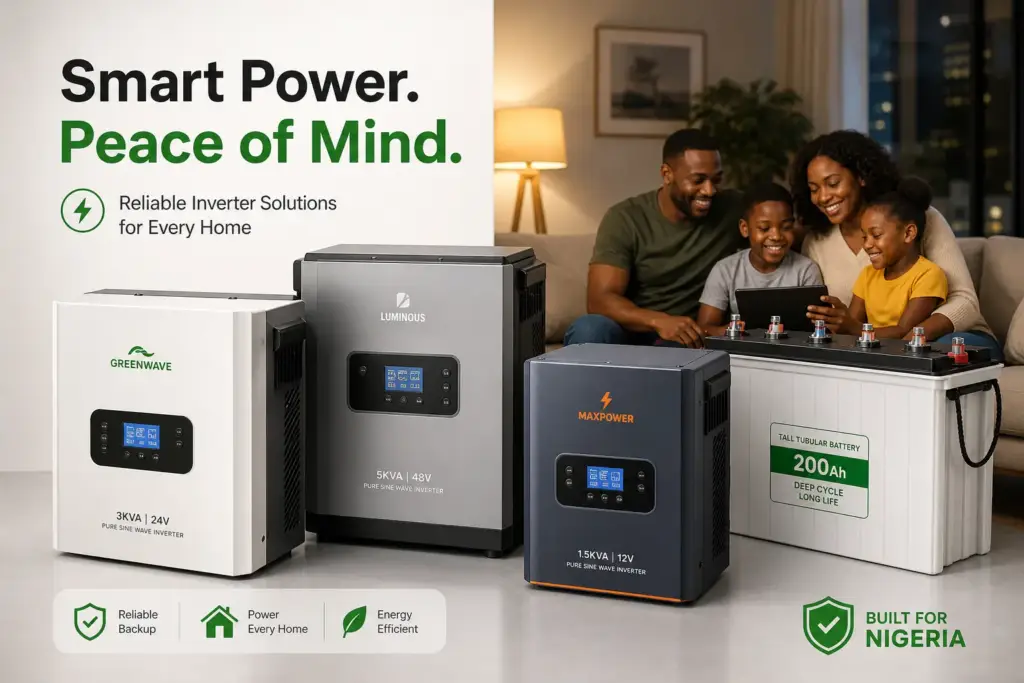
If you are searching for the best inverter for home Nigeria in 2026, this Solar Power Solutions guide is for you.
Many households report unpredictable PHCN supply with frequent, unplanned outages. Fuel costs have risen sharply since 2024, and every litre of petrol you burn is money that could go towards a permanent solution. If you are ready to invest in a home inverter system in 2026, the biggest mistake you can make is buying by price alone without matching capacity to your actual load.
This guide draws on over a decade of sizing and installing solar inverter systems across Nigeria at Solar Power Solutions. You will see capacity picks organised by house size, recommended battery pairings, realistic backup-time estimates, inverter prices Nigeria 2026, and what to expect when you install in a major Nigerian city. Pick the section that matches your home and budget, and you will leave with a clear shortlist.
Choose by load and house size, best inverter for home Nigeria basics
Quick size map by bedroom count
Based on our installation data across hundreds of Nigerian homes, a reliable rule of thumb puts a 1-bedroom flat at 1.5, 2 kVA, a 2-bedroom at 2.5, 3.5 kVA, and a 3-bedroom at 3.5, 5 kVA. To convert kVA to continuous watts, multiply by 0.8 (the standard power factor). That gives you roughly 1.2, 1.6 kW for a 1‑bed and 2.0, 2.8 kW for a 2‑bed. A 3‑bed sits in the 2.8, 4.0 kW band. Always add 20, 30% headroom above your calculated load to cover start‑up surges and the appliances you will add over the next two years. If you are unsure about kVA selection, our practical guide on how to choose the right inverter size for your home or small business can help.
What appliances actually drive kVA in Nigerian homes
Most people underestimate their load until they add up the numbers. A single ceiling fan draws about 75 W; a fridge runs at roughly 150 W steady‑state. The appliances that push you up a capacity class are the ones with compressors and motors: a water pump draws 750, 1,000 W, a microwave pulls ~1,200 W, and a 1 HP split‑unit AC demands around 1,000 W. Start‑up surge on a pump or compressor can be two to three times its running wattage, which is why one pump alone can force you from a 2 kVA to a 3.5 kVA unit.
Hybrid vs inverter‑only: when solar input saves you money
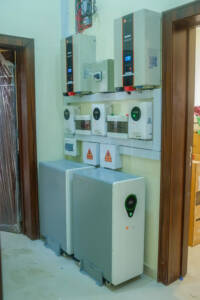
A standard inverter‑charger draws power from the grid or generator to charge your batteries. A hybrid inverter adds an inbuilt MPPT charge controller, so you can feed solar panels directly into the same unit and charge your batteries from sunlight during the day. If you plan to add panels within the next 6, 12 months, buying a hybrid from the start is almost always cheaper than retrofitting. Daytime solar charging cuts both your generator run‑time and your grid electricity spend, which improves payback time on the whole system. For practical panel sizing tips see how to size residential solar for Nigerian homes in 2026.
Pure sine wave for sensitive electronics
Every TV, laptop, router, and DSTV decoder in your home prefers clean, pure‑sine‑wave output. Modified‑sine‑wave inverters produce a stepped waveform that can cause heat build‑up in motors, humming in audio equipment, and shortened lifespan in power supplies. The recommended models from the brands below produce pure‑sine output, so your devices run much like they would on PHCN supply.
Best inverter for home Nigeria, 1, 2 kVA picks for studios and 1‑bed flats
Top pick: Luminous 1.5, 2 kVA pure‑sine‑wave inverter
Luminous has built its reputation in Nigeria on consistent daily cycling performance and clean output. The 1.5 kVA pure‑sine model handles a 1‑bed load comfortably: lights, ceiling fan, TV, laptop, decoder, and a small fridge. It operates on a 12 V system, which keeps battery costs lower for entry‑level setups. Solar Power Solutions offers warranty support for selected Luminous models; please check the exact terms for your product at purchase.
Runner‑up: Eastman 2 kVA solar hybrid with MPPT
The Eastman 2 kVA 24 V hybrid supports up to around 1,500 Wp of solar panels (per manufacturer specifications); confirm the exact PV input limit for your unit. You can add 400, 800 W of panels later and start reducing your dependence on grid charging. It delivers stable performance under essential loads and protects against over‑current, battery overcharge, and PV reverse polarity. For compact apartments where a solar upgrade is on the medium‑term plan, this is the smarter buy today.
Budget pick: Blue Power 1.5 kVA for essentials
Blue Power’s 1.5 kVA hybrid comes with an inbuilt 40 A MPPT and is available in both 12 V and 24 V configurations, with verified Nigeria prices from around ₦120,000 (confirm current pricing). It suits a budget‑conscious setup focused strictly on lights, fans, and entertainment. Keep kitchen heat loads off this unit entirely; a microwave or electric kettle will exceed its continuous output rating without difficulty.
Battery pairing and expected backup time
For this class, a 12 V 200 Ah tubular battery delivers roughly 6 hours at a 200 W load and about 4 hours at 300 W, assuming 50% depth of discharge to protect battery life (12 V × 200 Ah = 2,400 Wh nominal; ~1,200 Wh usable at 50%). If you prefer a smaller footprint and faster recharge, a 24 V 100 Ah LiFePO4 pack gives similar usable energy with deeper discharge headroom and better cycle life in Nigeria’s heat. Avoid connecting a freezer or pump to a 1, 2 kVA system; the surge current can trip the inverter and degrade your battery faster. For a practical runtime example see how long a 200Ah battery will last.
Best inverter for home Nigeria: 2.5, 3.5 kVA for 2‑bedroom homes
Best pick at 3.5 kVA: Felicity solar hybrid inverter
Felicity’s 3.5 kVA hybrid is a strong midweight option for Nigerian 2‑bedroom homes. Pure‑sine output and an inbuilt MPPT let you run multiple fans, a TV or two, a fridge‑freezer, and light kitchen use, with a solar panel array expandable as your budget allows. Local warranty terms can run up to two years in Nigeria (verify terms for your model), and 2026 prices sit in the ₦280,000, ₦320,000 range for the inverter unit alone based on current retail listings. That is solid value for a solar‑ready, pure‑sine machine at this capacity.
Runner‑up: Luminous 3.5 kVA pure‑sine‑wave inverter‑charger
If you want maximum reliability from the grid or generator today and plan to add an external MPPT charge controller for solar later, the Luminous 3.5 kVA inverter‑charger is the right choice. It has dependable grid‑charging behaviour, robust protection circuits, and a clean waveform that has been proven in Nigerian conditions for years. It is the safer pick for homes where solar integration is still 12, 18 months away.
Value pick: Blue Power 3 kVA hybrid
Blue Power’s 3 kVA hybrid with inbuilt 60 A MPPT offers hybrid flexibility without pushing into the ₦400,000+ bracket in many cases, though actual pricing varies by supplier and features. It is well‑suited to homes where the grid is erratic but not completely absent, and daytime solar can take the load during business hours. Pair it with a proper 24 V battery bank and you have a system that responds to both grid and sun.
Loads, surge behaviour, and the right batteries
At this capacity class, move to a 24 V battery bank: two 200 Ah tubular batteries in series give you 24 V 200 Ah, which delivers roughly 4 hours at a 600 W load at ~50% usable depth (24 V × 200 Ah = 4,800 Wh nominal; ~2,400 Wh usable). If you want longer cycle life and can absorb the higher upfront cost, a 24 V 100, 150 Ah LiFePO4 pack matches usable energy with better heat tolerance and roughly 2,000, 5,000 cycles. Cable sizing and MCB ratings matter at this level; undersized cables cause heat and voltage drop that erode both efficiency and safety. Have a qualified installer verify your wiring.
Best inverter for home Nigeria, 4, 5 kVA for 3‑bedroom family homes
Top pick at 5 kVA: Luminous 48 V pure‑sine‑wave inverter
The Luminous I‑Cruze 5 kVA 48 V pure‑sine‑wave inverter is one of the most consistently recommended units for Nigerian family homes, and current 2026 pricing places it at around ₦980,000 for the inverter unit (verify against current listings). The 48 V architecture reduces current draw at a given power level, which improves efficiency and makes battery charging faster and more stable. It handles multiple fans, a large fridge‑freezer, washing machine cycles, and light‑duty power tools without flinching, and the protection stack covers common Nigerian fault conditions. It comes with a one‑year manufacturer’s warranty.
Runner‑up: Eastman 5 kVA hybrid with MPPT
The Eastman 5 kVA hybrid consolidates solar charge control and inverter functions into one enclosure, which simplifies both installation and fault‑finding. If you plan to commission 1.2, 2.4 kW of solar panels within the year, this one‑box approach saves installation time and wiring cost. Power quality under mixed loads is consistent, which matters in a 3‑bedroom home where the load profile shifts throughout the day. As of 2026 no single verified retail price is publicly pinned for this model, so request a current quote from Solar Power Solutions directly.
When 7.5 kVA or inverter AC makes sense
If you run a borehole pump frequently, operate a freezer business from home, or want more than two hours of air conditioning daily, a 5 kVA system will get stressed by those loads consistently. Stepping up to a 7.5 kVA unit or pairing your 5 kVA system with inverter‑grade split ACs (which can be significantly more efficient than conventional units, depending on model) is a more sustainable approach. The trade‑off is a larger battery bank and a higher total system budget, but the per‑hour running cost drops sharply once solar panels are online.
Battery stacks and real backup estimates
At 48 V, stack four 200 Ah tubular batteries in series for a 48 V 200 Ah bank. At a continuous 1,000 W load with 50% depth of discharge, that bank gives you roughly 5, 5.5 hours of backup. Switch to a 48 V 200 Ah LiFePO4 pack and the same load delivers ~7.7, 8.6 hours because of the deeper usable discharge. Allow for inverter efficiency of about 85, 90% in real‑world conditions, which will trim these headline runtimes slightly. Kitchen heat appliances shrink backup time fast: a microwave running for just 20 minutes at 1,200 W consumes ~400 Wh (1,200 W × 0.333 h), which equals two hours at a 200 W baseline load. Keep high‑wattage cooking off the inverter circuit where possible.
Battery pairing and backup time cheat sheet
Tubular vs AGM vs LiFePO4 in Nigerian heat
Tubular lead‑acid batteries are still the most practical choice for most Nigerian homes: they tolerate deep discharge better than flat‑plate batteries, handle high ambient temperatures reasonably well, and cost significantly less per kWh than lithium options.
AGM batteries are sealed and low‑maintenance, making them a sensible pick for clinics, small offices, and installations where regular water top‑ups are inconvenient.
LiFePO4 wins on cycle life (typically 2,000, 5,000 cycles versus ~300, 500 for tubular in similar use) and usable depth of discharge (often 80, 90% versus ~50%), but the higher upfront cost means the payback period is longer. For most Nigerian households today, tubular is the value choice; LiFePO4 makes sense if you are building a system designed to last 10+ years. For a detailed comparison see lithium vs tubular battery in Nigeria.
Simple run‑time math you can trust
The formula is: usable Wh divided by load W equals hours. A 24 V 400 Ah tubular bank stores 9,600 Wh nominally; at 50% usable depth, that is 4,800 Wh. At 600 W, you get ~8 hours. At 1,000 W, you get just under 5 hours. For LiFePO4, use 80, 90% as your usable depth instead of 50%, which is why a smaller LiFePO4 pack often out‑runs a larger lead‑acid bank in real‑world use.
Compatibility and maintenance notes
LiFePO4 batteries need an inverter that supports lithium charging profiles or BMS communication. Loading a lithium pack onto an older inverter configured for lead‑acid can overcharge it, void your warranty, and create a safety risk. Always confirm charging profile settings at installation. For tubular flooded batteries, use distilled/deionised water for top‑ups where recommended by the battery maker, check electrolyte levels every two to three months, and keep the battery bay well‑ventilated to avoid hydrogen build‑up. Periodic cable‑torque checks and dust control around terminals make a measurable difference to battery life in Nigeria’s climate.
2026 price guide, installation costs, and where to buy
Inverter prices in Nigeria 2026 by capacity
Below are realistic 2026 price ranges based on current retail listings and market quotes. Hybrid and MPPT models carry a premium over inverter‑only units at the same capacity, and 48 V architecture typically costs more than 12 V or 24 V equivalents.
- 1.5, 2 kVA pure sine / hybrid: ₦120,000, ₦300,000
- 3, 3.5 kVA hybrid MPPT: ₦280,000, ₦480,000
- 5 kVA pure sine 48 V: ₦499,000, ₦980,000 depending on brand and features
These figures cover the inverter unit only. Batteries, panels, cabling, and installation are separate line items, and the total system cost for a fully installed 5 kVA setup often exceeds ₦2,000,000 depending on battery choice, panel size, and site conditions.
Best inverter brands we stock and why
At Solar Power Solutions, we stock Luminous, Eastman, Felicity, and Blue Power because they offer verified pure‑sine‑wave models, genuine hybrid options with inbuilt MPPT, and local parts availability that makes warranty claims actionable rather than theoretical. Generic brands with no Nigerian support infrastructure are cheaper to buy and much more expensive to fix. We stock models for which the manufacturer supplies warranty through our authorised channels; please verify the exact warranty terms at point of sale. If you are comparing the best inverter brands Nigeria offers, we can help you match features and support to your needs.
Installation and cabling budgets in major cities
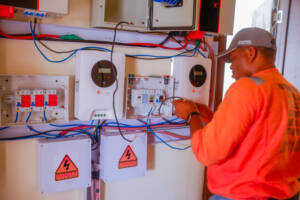
Typical installation budgets for residential systems in Nigerian cities follow a fairly consistent pattern. A small 1, 2 kVA setup runs ₦80,000, ₦200,000 for labour, wiring, and accessories bundled together. A mid‑range 3.5, 5 kVA system budgets ₦150,000, ₦250,000 for the same scope. Larger or more complex systems start at ₦300,000 and climb from there. Lagos, Abuja, and Port Harcourt tend to sit at the higher end of these ranges due to logistics and the complexity of urban site work.
Get your system from Solar Power Solutions
Solar Power Solutions offers nationwide shipping and professional installation in major Nigerian cities including Lagos, Abuja, and Port Harcourt; contact us for current coverage and terms. We size your system based on your actual load, house layout, and budget, not on what happens to be in stock. If you are comparing models or not sure where to start, send us a message and we will put together a tailored quote at current 2026 pricing. We also advise on inverter battery compatibility Nigeria buyers often ask about, so your lithium or tubular bank matches your charger profile.
The right home inverter in Nigeria starts with an honest load count, a kVA figure that matches your bedroom count and appliance mix, and a battery bank sized for the backup hours you actually need. Whether you choose a pure‑sine inverter‑only unit today or go straight to a hybrid for future solar panels, each recommended model is available in a pure‑sine variant and can be purchased with local warranty options, confirm model and warranty at time of purchase. For the best inverter for home Nigeria and up‑to‑date inverter prices Nigeria 2026, message Solar Power Solutions for a custom plan, current pricing, and professional installation that protects your investment from day one.
